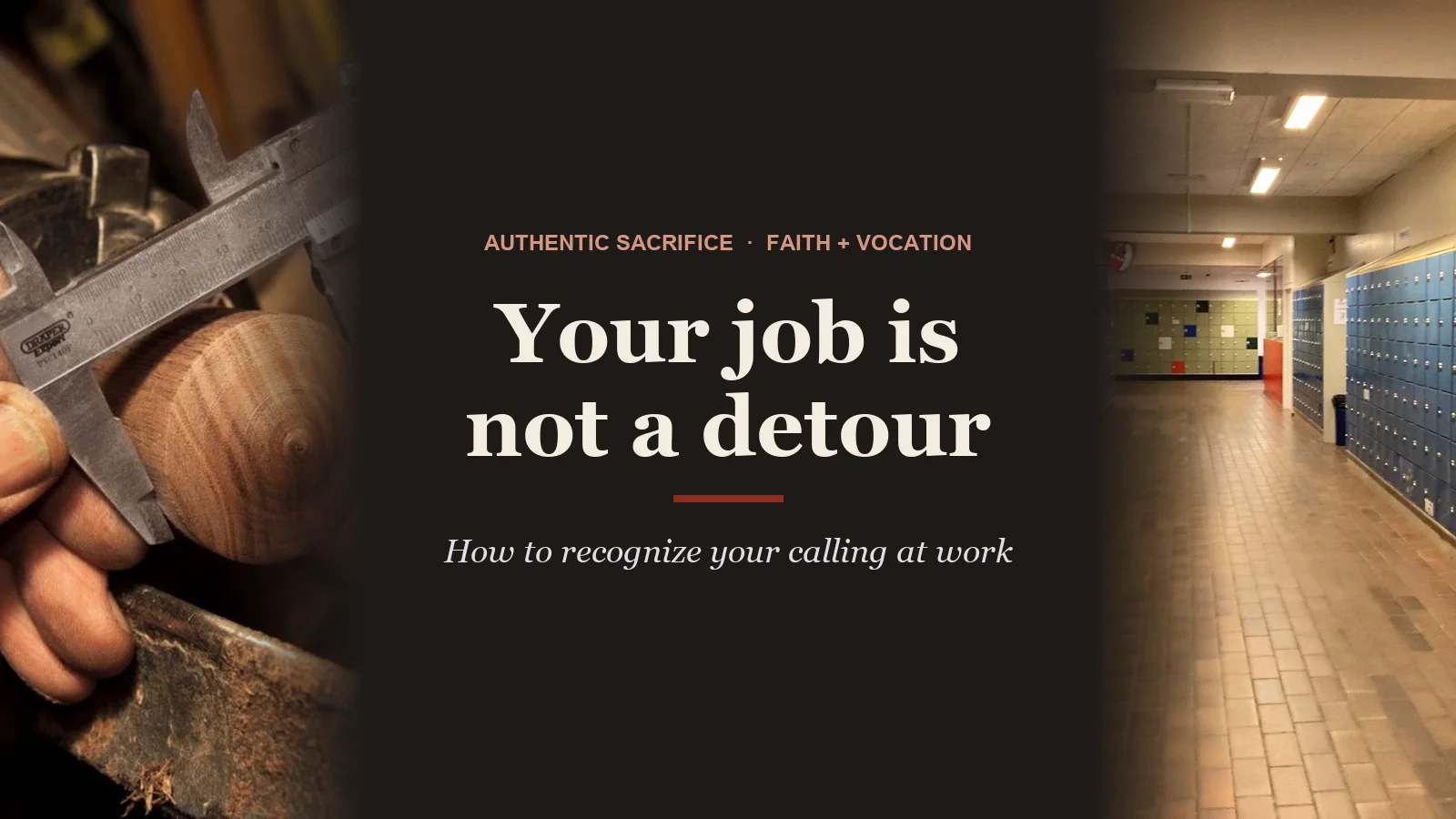
Is Your Job Your Ministry? How to Recognize Your Calling at Work
Picture an elementary school custodian turning his key in the side door at 5:45 a.m. He props open the gym, checks the boiler and runs a dust mop down the hall before the first bus pulls in.
A third-grader who cries at drop-off most mornings has learned to look for him. He waves, says her name and asks about her dog. Then she walks into class.
Years ago he thought he might become a pastor. Some days he wonders whether he missed his calling. He may be standing right in the middle of it.
Quick answer
Your calling at work is the way God uses your daily job to serve others and honor him. Scripture says "whatever you do, do it all for the glory of God" (1 Corinthians 10:31, NIV). You can recognize it when your work meets real needs, uses your gifts, and gives you chances to show faithfulness, integrity and love.
Key takeaways
- Scripture treats ordinary work as a way to serve God, not a lesser path.
- In a 2018 Barna study, only 3% of Christians called school janitor 'usually a calling.'
- Calling shows up in who your work serves, not only in your job title.
- A hard job can still be a faithful place to serve for a season.
- Live out faith at work through excellence, honesty and care more than words.
What does “calling” mean in the Bible?
In Scripture, calling starts with a person before it points to a job. God calls people to himself first. Then he sends them into the places where they already live and work.
Work itself is part of the original design. Genesis 2:15 (NIV) says, “The Lord God took the man and put him in the Garden of Eden to work it and take care of it.” Work came before the fall. It was never meant to be a curse to escape, but a way to care for what God made.
Paul makes the same point to first-century believers who wondered whether they had to change their circumstances to follow Jesus. In 1 Corinthians 7:17 (NIV), he writes, “each person should live as a believer in whatever situation the Lord has assigned to them, just as God has called them.”
And Ephesians 2:10 (NIV) adds a hopeful detail: “For we are God’s handiwork, created in Christ Jesus to do good works, which God prepared in advance for us to do.” Some of those good works are waiting at your job on Monday morning.
Do most Christians see their work as a calling?
More than they used to. Barna Group’s 2018 Christians at Work study, summarized by The Gospel Coalition, found that five years earlier about a third of employed Christians (34%) had never even thought about whether they felt called to their work. By 2018, that share had dropped to 15%.
Most respondents also rejected the idea that ministry jobs are better. Asked to compare becoming a pastor or missionary with representing their faith at work, 64% said neither was better, 12% favored the pastor or missionary and 25% favored representing faith at work.
But a ranking crept back in when people rated specific jobs. In the same study, 69% said being a pastor is “usually a calling,” and 52% said the same of parenting. For a school janitor, the figure was just 3%, though another 32% said it is “sometimes a calling.”
That gap matters for the custodian at the side door. It matters for anyone who quietly assumes God values their work less than someone else’s.

Is your job your ministry?
For most Christians, yes, though not in the sense of turning every shift into a sermon. Your job is one of the main places where your faith becomes visible and useful to other people.
Paul’s most sweeping statement about ordinary life comes in the middle of a discussion about something as everyday as dinner. In 1 Corinthians 10:31 (NIV), he writes: “So whether you eat or drink or whatever you do, do it all for the glory of God.”
If eating and drinking can honor God, so can a shift at the warehouse. That phrase, “whatever you do,” changes how a long day feels. The spreadsheet, the patient chart, the delivery route and the classroom are all places where you honor God by serving people well.
A healthy view of calling also keeps work in its place. Your job is a calling, but it is not your only one. You are also called to your family, your church, your friends and your neighbors. When work swallows every other calling, something has gone wrong.
For a real-world look at building a career around purpose, read our feature on faith, vocation and building with purpose.
“For we are God’s handiwork, created in Christ Jesus to do good works, which God prepared in advance for us to do.”
Ephesians 2:10 (NIV)
How can you recognize your calling at work?
Calling is rarely a single dramatic moment. More often it is a pattern you notice over time. Here are six signs to look for.
1. You can name who your work serves
Every job serves someone: a customer, a patient, a student, a coworker, a family who depends on your paycheck. If you can picture the faces your work helps, you are looking at the heart of your calling.
2. Your gifts are being used
1 Peter 4:10 (NIV) says, “Each of you should use whatever gift you have received to serve others, as faithful stewards of God’s grace in its various forms.” In the Barna study, 42% of working Christians strongly agreed that their strengths and abilities are used in their present job, and another 43% somewhat agreed.
3. You notice needs other people miss
The custodian notices the crying third-grader. A nurse notices the family member who hasn’t eaten. An accountant notices the client who is quietly panicking. Paying attention is often the first step of serving.
4. You are faithful in small things
Jesus said in Luke 16:10 (NIV), “Whoever can be trusted with very little can also be trusted with much.” Showing up on time, doing honest work when no one checks and finishing the boring parts well are all marks of a calling lived out.
5. Others confirm it
Calling is not only an inner feeling. Pay attention when coworkers, mentors or your church repeatedly tell you that you are good at something and that it helps people. That kind of confirmation is worth taking seriously.
6. Your work makes room for love
Some jobs are hard and unglamorous. Even there, ask whether the role gives you daily chances to be patient, honest, generous and kind. If it does, it is already doing ministry work in you and through you.
What if your job feels meaningless right now?
You are not alone. Gallup’s latest data on the U.S. workplace found that 32% of employees are engaged at work, based on a three-year average ending in 2025. Most people spend part of their working lives in seasons that feel flat.
Scripture speaks to that, too. When God’s people were carried into exile in Babylon, a place they never chose, the prophet told them to build houses, plant gardens and work for the good of the city. In Jeremiah 29:7 (NIV), God says, “seek the peace and prosperity of the city to which I have carried you into exile. Pray to the Lord for it, because if it prospers, you too will prosper.”
Callings often grow out of seasons no one would choose. Our profile of a CEO who rebuilt after homelessness shows how hard chapters can shape the work that comes next.
A hard season can still be a faithful season. That doesn’t mean you must stay forever. It is fine to pray about a change, talk with trusted mentors and plan your next step. If a move affects your family’s finances, a qualified financial professional can help you think it through.
Churches can help here, though not all do. In Barna’s 2018 report on the church’s role in vocation, 53% of churchgoing Christians strongly agreed that their churches help them understand how to live out their faith at work, and 45% said they definitely feel supported in their careers by their church. If you need that support, ask for it.
How do you live out your faith at work without preaching?
Most of the time, faith at work is quiet. It shows up in how you treat people and how you do the job.
- Do excellent work. Proverbs 22:29 (NIV) asks, “Do you see someone skilled in their work? They will serve before kings.”
- Tell the truth. Honest timesheets, honest reports and honest mistakes build trust faster than any speech.
- Treat people with dignity. The person with the least power in the room deserves the same respect as the boss.
- Pray for your coworkers. You don’t need permission to pray quietly for the people you work with.
- Respect your workplace. Follow your employer’s policies, and share your faith when someone asks, with gentleness and respect.
Jesus put it simply in Matthew 5:16 (NIV): “let your light shine before others, that they may see your good deeds and glorify your Father in heaven.” Good deeds come first. Questions often follow.
If you lead a team, the stakes are higher. Our piece on ethical leadership in modern organizations looks at how integrity shapes a whole workplace culture.

What questions can help you discern your calling this week?
Set aside 15 minutes and write honest answers to these:
- Who did my work help this week, even in a small way?
- Which tasks give me energy, and which drain me?
- What do people regularly thank me for or ask me to help with?
- Where did I have a chance to show patience, honesty or kindness?
- What would it look like to do this job “for the glory of God” tomorrow?
Bring your answers to a mentor, a pastor or a friend who knows you well. Calling becomes clearer in conversation.
Back at the elementary school, the bell rings and the halls fill. The custodian pushes his cart past the third-grade classroom, where the girl who cried at drop-off is now raising her hand. No one will put his job on a list of holy callings. But every morning, at a side door, a frightened child learns that someone sees her. That is not a detour from ministry. That is ministry.
Share your story
Have you seen God at work in your job, whether in a classroom, a warehouse, a hospital or an office? Tell us how faith shows up in your workday. Your story may help someone who feels their work doesn’t count.
Frequently asked questions
What is the difference between a job and a calling?
A job is the work you are paid to do. A calling is the larger purpose God gives your life, which can include your job, your family, your church and your community. Many Christians understand their job as one important place where they live out their calling.
How do I know if God is calling me to change jobs?
Pray, pay attention to recurring desires and open doors, and seek counsel from people who know you well. A call to change usually becomes clearer over time rather than all at once. For decisions that affect your family's finances, it is wise to talk with a qualified professional as well.
Is full-time ministry a higher calling than other work?
Scripture honors pastors and missionaries, but it also treats ordinary work as service to God. In a 2018 Barna study, 64% of working Christians said neither becoming a pastor nor representing faith at work is better than the other.
Can a secular job be a ministry?
Yes. In 1 Corinthians 10:31, Paul tells believers to do whatever they do for the glory of God. A secular job becomes ministry as you serve people well, work with integrity and show the love of Christ in daily interactions.
What does the Bible say about work?
The Bible presents work as part of God's original design, beginning with Adam caring for the garden in Genesis 2:15. It calls believers to work wholeheartedly, honestly and for the good of others, and it also calls them to rest.
Sources
- The Gospel Coalition: Study: American Christians Are Erasing the Divide Between 'Sacred' and 'Secular' Jobs
- Bible Gateway: 1 Corinthians 10:31 (NIV)
- Gallup: State of the Global Workplace, United States Country-Level Data
- Bible Gateway: Jeremiah 29:4-7 (NIV)
- Barna Group: Christians at Work, Part 3: The Church's Role